

A well-written WiFi RFP (Request for Proposal) is the difference between a procurement process that attracts qualified vendors with comparable, evaluable proposals — and a process that generates apples-to-oranges bids that make vendor selection a guessing game. For a 50,000 sq ft warehouse deployment specifically, the RFP needs to address the unique technical requirements of industrial WiFi environments. Here's how to build one that works.
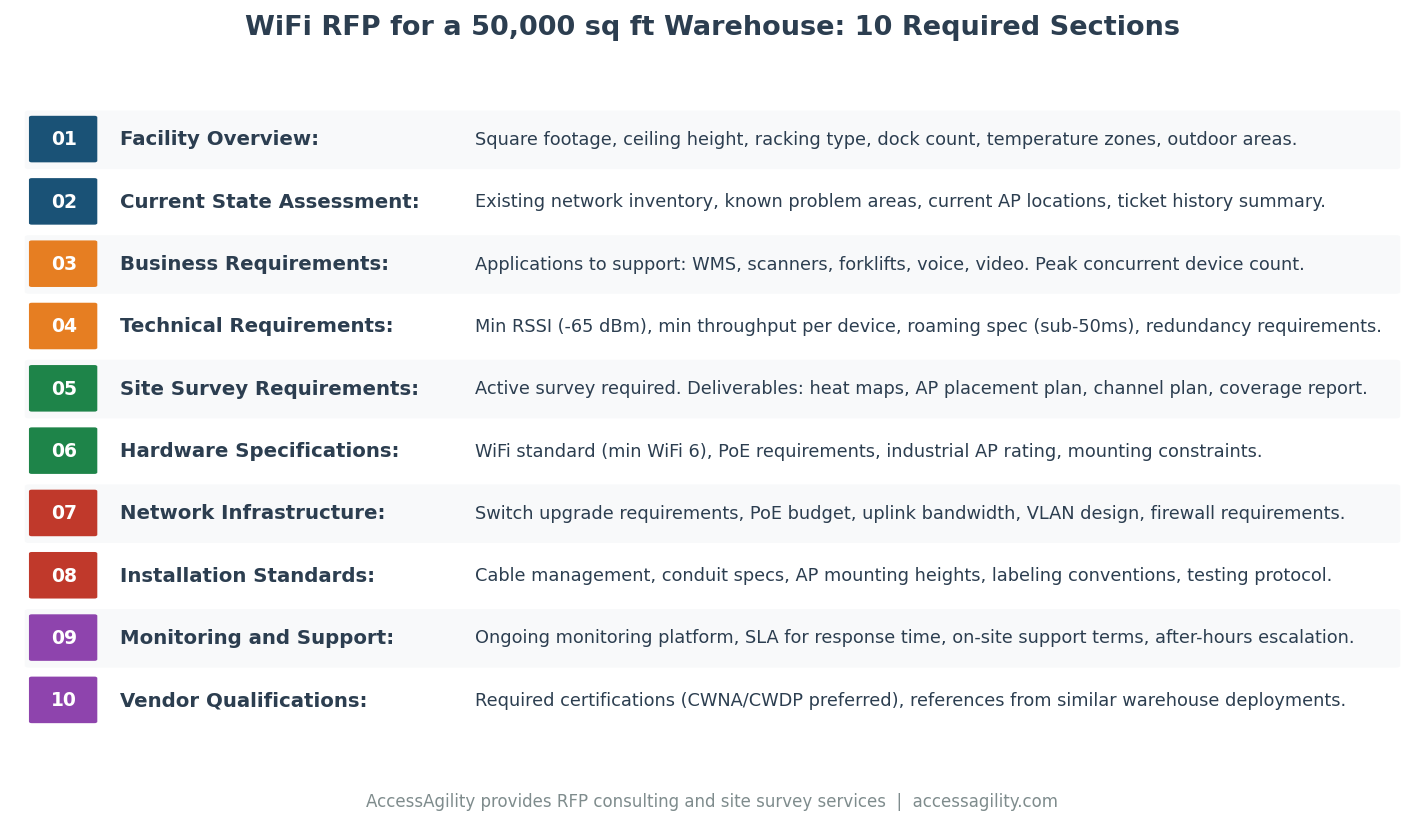
Section 1: Project Overview and Scope
Define the facility clearly: total square footage, building height, number of floors, number of distinct operational zones (receiving, storage, picking, shipping, office area), and any areas with unusual RF challenges (freezer zones, high-voltage equipment areas, automated conveyor systems).
State the operational requirements: shift patterns (24/7 or business hours), peak concurrent device count, device types (barcode scanners, forklifts/AGVs, tablets, IoT sensors, staff devices), and any specific applications with performance requirements (WMS, VoIP, real-time inventory tracking).
Section 2: Technical Requirements
WiFi standard: Specify minimum WiFi 6E (802.11ax, tri-band) for all new AP installations. This establishes a baseline that ensures you're procuring current-generation hardware.
Coverage requirements: "Full coverage throughout all areas" is not a specification — it's an aspiration. Specify minimum RSSI (-67 dBm for scanner areas, -70 dBm for standard coverage zones), minimum SNR (25 dB in operating areas), and minimum data rate requirements at coverage boundaries (12 Mbps minimum for scanner applications; 54 Mbps minimum for video and VDI-capable zones).
Capacity requirements: State peak concurrent device counts per zone and per AP. For example: "The picking zone (15,000 sq ft) must support 120 concurrent barcode scanner associations with minimum 5 Mbps per device during peak shift." This forces vendors to design for capacity, not just coverage.
Roaming requirements: "Seamless roaming" is not a specification. Specify: maximum roaming transition time (< 50ms for forklift applications, < 100ms for scanner applications), required fast roaming protocols (802.11r, 802.11k, 802.11v), and maximum number of roaming events per minute per mobile device at rated vehicle speed.
Environmental requirements: Specify IP rating for all APs (minimum IP52 for standard warehouse; IP67 for freezer or outdoor areas), operating temperature range, and any certifications required (UL, FCC Part 15).
Security requirements: WPA3-Enterprise or WPA2-Enterprise with 802.1X for staff SSIDs; WPA2-PSK with VLAN segmentation for scanner SSIDs; management network isolated from production SSIDs; rogue AP detection capability on wireless controller or management platform.
Section 3: Required Deliverables
The deliverables section determines what you receive and how you evaluate compliance with your requirements.
Pre-deployment: Predictive RF design with floor plan overlay showing AP locations, channel assignments, and predicted RSSI coverage maps. Bill of materials with make/model/quantity for all hardware. Network topology diagram showing AP-to-switch connectivity and VLAN architecture.
During installation: Site visit documentation confirming AP locations match the RF design. Deviation log if any APs were installed off-specification with justification.
Post-deployment: Post-deployment validation survey report with passive and active survey data. Side-by-side comparison of predicted vs. actual coverage. Roaming validation walk data. Written remediation plan for any areas that failed to meet specification.
Section 4: Evaluation Criteria
Weight your evaluation criteria to reflect what matters most: technical approach and RF design methodology (40%), prior experience with warehouse environments of similar scale (30%), price (20%), and support/warranty terms (10%). Require vendors to provide at least two references from comparable warehouse WiFi deployments.
Section 5: What to Watch Out For
Be cautious of proposals that: specify AP quantities without a supporting RF design; provide "heatmaps" generated by vendor planning tools without physical survey data; quote on WiFi 5 or non-tri-band hardware; or propose pricing that is significantly below other bidders without a clear explanation of how they're meeting your specification.
AccessAgility is available to assist procurement teams in developing technical specifications for WiFi RFPs and can provide independent RF assessment services to validate vendor-submitted designs before contract award.
Need expert WiFi design, tools, or government WiFi procurement?
AccessAgility provides professional WiFi surveys, RF design, monitoring tools, and SEWP-contracted WiFi services for enterprise and government environments.
Get a Free WiFi Assessment ›