

Every year, thousands of businesses deploy consumer-grade WiFi routers and access points because they're cheaper than enterprise hardware. It feels like a reasonable cost decision. It isn't. Consumer-grade WiFi creates productivity losses, security exposures, and support costs that routinely exceed the hardware cost savings multiple times over. Here's the real math.
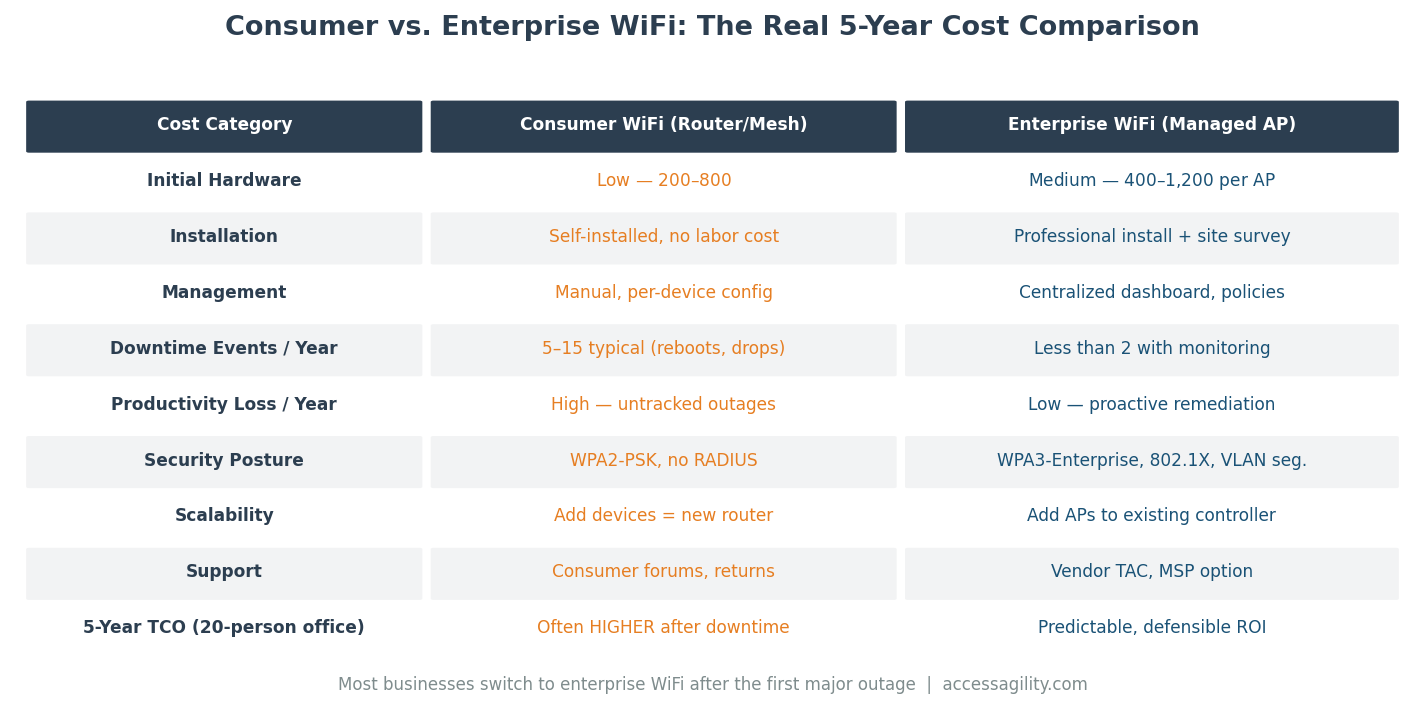
The Upfront Cost Comparison (What Looks Appealing)
A consumer-grade WiFi router from Netgear, TP-Link, or similar costs $100–$300 and claims coverage for an entire office floor. An enterprise-grade AP from Cisco or Aruba with professional installation costs $500–$1,200 per AP plus design and configuration time. The consumer option looks 5x–10x cheaper upfront. This is the calculation that leads businesses astray.
What Consumer Hardware Cannot Deliver
RADIUS authentication: Consumer APs use pre-shared key (PSK) authentication only. When an employee leaves, changing the PSK requires reconfiguring every device on the network. With enterprise authentication (802.1X), you revoke one user certificate, and that person loses access — everything else continues working unchanged.
VLAN segmentation: Consumer APs cannot separate guest users from corporate traffic at the VLAN level. Your visitors are on the same network as your financial systems.
Band steering and QoS: Consumer APs cannot enforce band steering, which means legacy devices crowd the 2.4 GHz band and degrade performance for everyone. There is no QoS policy enforcement to prioritize VoIP or video over file downloads.
Capacity under load: Consumer APs are designed for 10–20 simultaneous devices in a home environment. In a 30-person office, performance during peak morning hours is typically unacceptable.
Central management: Each consumer AP requires independent configuration. For a multi-AP deployment, there is no centralized management, no consistent policy enforcement, and no single-pane visibility into network health.
The Hidden Costs
IT support time: Consumer APs require manual troubleshooting for each device complaint. Without centralized logging or management, diagnosing WiFi issues requires physical interaction with each AP. Conservative estimates put consumer AP support time at 3–5x that of enterprise equipment for the same-size deployment.
Productivity losses: Poor WiFi performance (which consumer APs deliver under office load) costs knowledge workers approximately 1 hour per week in lost productivity. At $60/hour fully loaded cost, that's $3,000 per employee per year. For a 20-person office, that's $60,000 annually in productivity losses attributable to inadequate WiFi.
Security incidents: The absence of 802.1X authentication, network segmentation, and rogue AP detection creates security exposure. A single security incident attributable to poor WiFi security will cost more than the entire enterprise WiFi hardware budget.
The Break-Even Calculation
A 20-AP enterprise WiFi deployment at $15,000 (hardware, design, installation) vs. a consumer-AP deployment at $3,000 represents a $12,000 cost difference. If the enterprise deployment eliminates $5,000/year in support costs and $10,000/year in productivity losses, the break-even is achieved in less than 12 months.
AccessAgility can help you build the business case for enterprise WiFi with an RF assessment and deployment design that demonstrates exactly what's needed and what it costs.
Need expert WiFi design or assessment for your facility?
AccessAgility provides professional WiFi surveys, RF design, and monitoring tools for enterprise and government environments.
Get a Free WiFi Assessment ›