

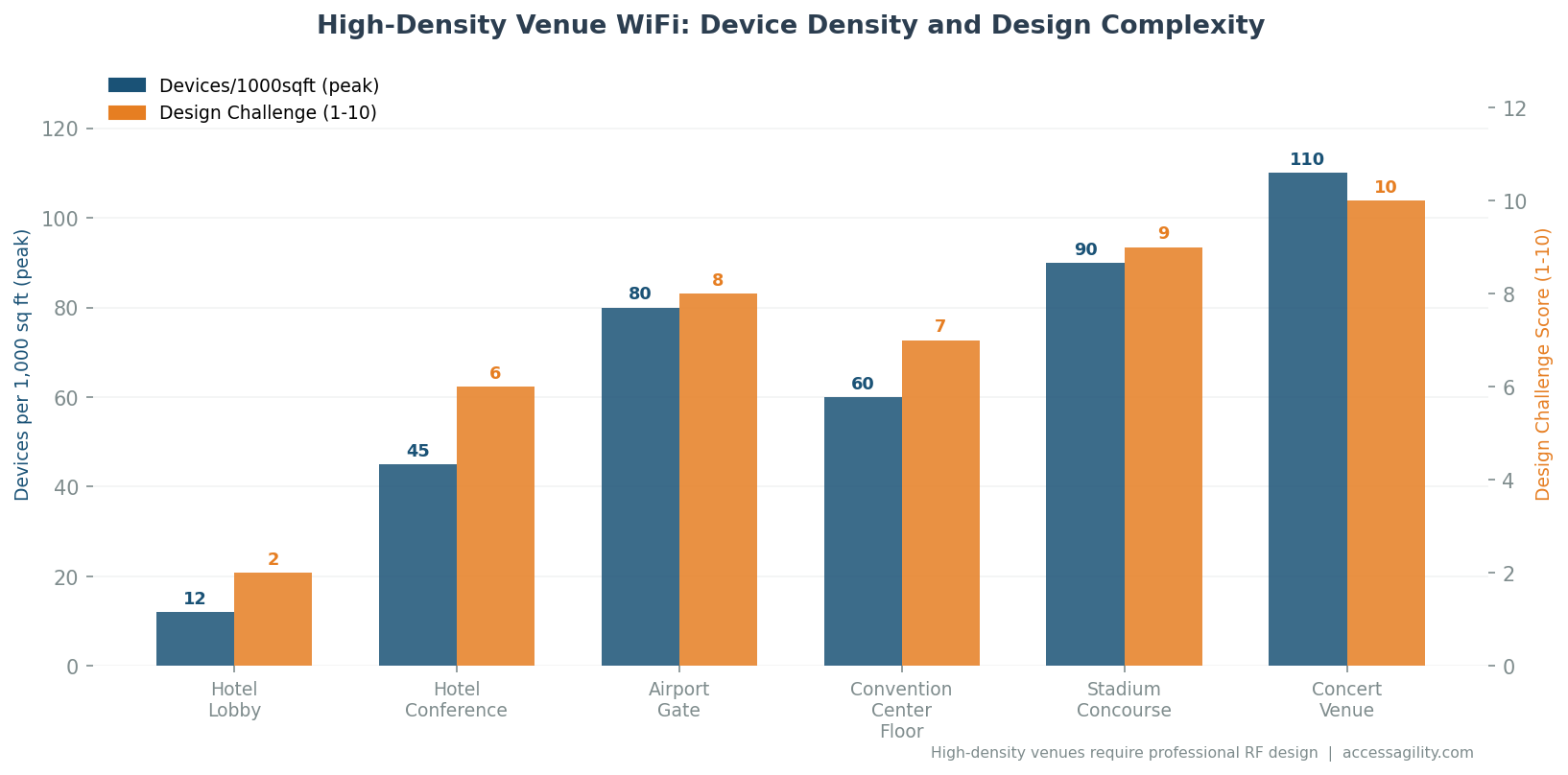
Airport and convention center WiFi failures are some of the most visible WiFi problems in the world. Tens of thousands of people simultaneously attempting to connect their devices, upload photos, join calls, and stream content — in a building whose WiFi was almost certainly designed for a fraction of that concurrent load. Here's why large public venue WiFi fails so predictably, and the design approaches that actually work.
The Core Problem: Unpredictable Peak Loads
Airports and convention centers have the most volatile device density of any WiFi environment. A convention center is empty on Sunday night and has 5,000 simultaneous users on Monday morning. An airport gate has 20 people waiting at 6 AM and 300 at 7 AM. Standard enterprise WiFi design, which sizes for average load with peak capacity headroom, consistently fails in these environments because the "peak" is 10x–20x the average.
Why the Current Deployment Usually Isn't Enough
Most large public venues were built with WiFi infrastructure designed 5–10 years ago for a lower expected device density. Since then, per-person device counts have grown from 1–2 to 3–5+ devices, streaming quality expectations have increased bandwidth demands 5x, and the emergence of video calling as a standard travel activity has added latency-sensitive load that didn't exist in the original design.
The existing physical infrastructure (cabling, mounting locations, power) often constrains what can be upgraded without a major renovation, leading to compromises that the average guest experiences as consistently poor WiFi performance.
Design Principles That Work for Public Venues
Sector antenna arrays for large open spaces: Terminal halls, convention floors, and exhibition areas benefit from ceiling-mounted sector antenna arrays rather than standard omnidirectional APs. Sectors direct RF energy toward the floor where users are, improving signal strength at user device height while reducing inter-AP interference overhead.
Capacity sizing for peak, not average: Design for the worst case: 100% occupancy, every person with 3 devices, all actively using streaming and video calling simultaneously. Then add 30% headroom. This design will be "oversized" 90% of the time — and just adequate the 10% of the time it actually matters.
Per-user bandwidth policies: In public WiFi environments, some users will consume 10x the bandwidth of average users. Per-user bandwidth limits (typically 25–50 Mbps) ensure that a few heavy users don't degrade the experience for everyone else during peak congestion.
6 GHz for high-density zones: The 6 GHz band's clean spectrum and WiFi 6E-only access make it ideal for high-density areas where legacy device interference compounds performance problems. Gate areas and exhibition halls should maximize 6 GHz usage for capable devices.
AccessAgility's large venue WiFi design and validation services include load testing under simulated peak conditions — the only way to validate a public venue WiFi deployment before opening day.
Need expert WiFi design or assessment for your facility?
AccessAgility provides professional WiFi surveys, RF design, and monitoring tools for enterprise and government environments.
Get a Free WiFi Assessment ›